

Two-Minute Titans: The Business Model Behind Micro-Dramas
Inside the storytelling engines turning screen time into spend, and what it means for your next greenlight.
I’m on my usual Western Line crawl from Parramatta to Central, AirPods locked on Neil Gaiman’s Norse Mythology while my thumb doom‑scrolls LinkedIn for the latest content gossip. Across the aisle, a student, UNSW hoodie, funky headphones, leans in so close to his phone you’d swear it owed them rent.
Nah, no cat loops. No dance‑trend lip syncs. They are deep into a binge of The Billionaire Female CEO from the Trailer Park, a ReelShort exclusive, and it seems like a breakout hit, as they tell me.
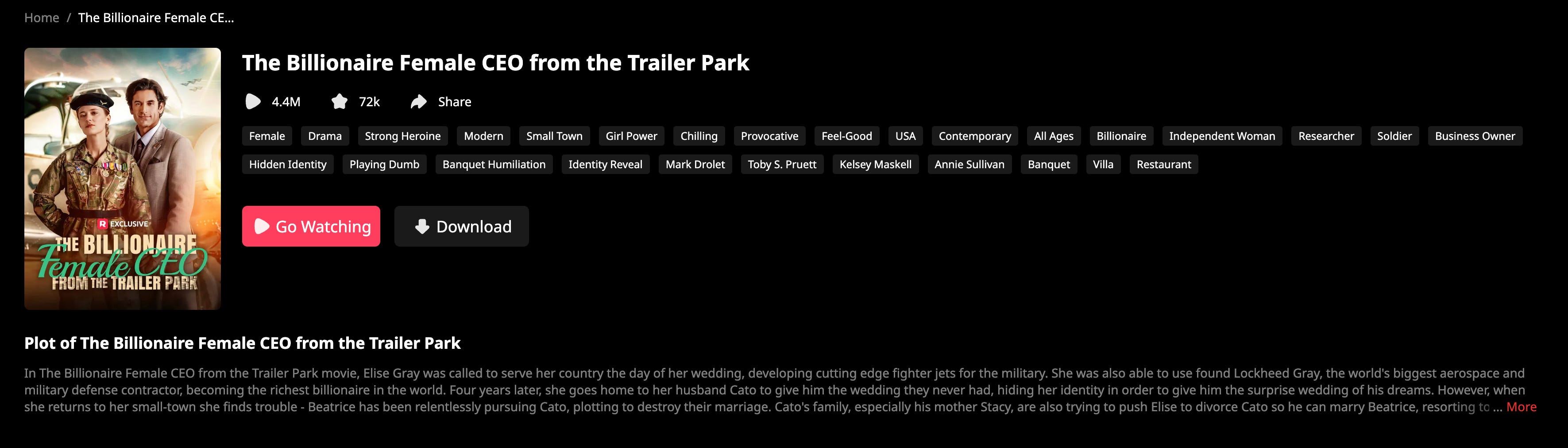
Each chapter runs under three minutes, swerves into melodrama, then, whack, a gold-coin icon slams the screen.
“Mate, how much have you dropped on this?” I lean across the aisle.
They chuckle: “About two to four bucks so far. The first 17 episodes were free, and then the episodes are a dime each. Sometimes it’s bumps to fifteen, sometimes twenty cents.”
They break it down like a seasoned day‑trader: watch an ad, unlock an episode free, up to twenty a day; bank coins from daily check‑ins and referral spins; or just pay straight up to dodge the ads and skip the queue.
By the time we roll past Strathfield, they are already an act ahead, thumb poised over the next coin‑drop, grin widening with every twist.
Figuratively speaking, that sixty‑second burst of melodrama just earned more per minute than most prime‑time pilots.
And folks, that’s the tidal shift we’re unpacking: bite‑sized stories, mobile‑first funnels, and AI‑greased pipelines redefining what a minute of screen time is worth.
So top up your in‑app coins, or just keep scrolling. By the end of this read, we will aim to understand exactly why the big money is hiding in the small screen.
The money shot: micro‑drama’s rocket‑fuel growth
Alright, let’s get straight to the bank. Micro-dramas aren’t just a fringe experiment anymore; they’re a full-blown industrial strategy. If you thought vertical video peaked with TikTok dance trends, think again.
In 2024, China’s vertical drama economy crossed US$5 billion in annual revenue. That’s not niche, that’s early Netflix energy. Meanwhile, short-drama apps like ReelShort, DramaBox, and Kuaishou Theatre have reported a combined US$146 million in Q1 2024 alone, up from just US$1.8 million the same quarter in 2023. You’re looking at 8,000% year-on-year growth. That’s not just a spike, that’s a tectonic shift.
But, how are they pulling this off?
Well, with two things: micro-payments and emotional manipulation. Each series is structured like a dopamine slot machine, free episodes hook you in, then come the cliffhangers and coin-drops. At ten to twenty cents a pop, you don’t feel it… until you’ve spent $40 before bedtime.
The monetisation model is pulled directly from mobile gaming, offering a free-to-play hook, then layering incentives: ads for coins, referrals for bonuses, timed unlocks, and a premium tier to skip the noise. ReelShort’s average ARPDAU (Average Revenue Per Daily Active User) is now competitive with mid-tier mobile games.
Creative strategy tip: If you’re developing micro-drama IP, start with narrative loops that maximise emotional investment in the shortest time. Treat each episode as both story and sales trigger.
Why viewers pay for what they used to ignore
Let’s unpack the economics behind the madness. The reason short-form dramas are generating real money is that they’ve borrowed the monetisation blueprint from mobile games.
Enter the cliff-and-coin funnel, a strategy that turns passive scrollers into active spenders. Here’s how it works:
1. First taste is free. Think of it like a digital hit. The first 8 to 10 episodes drop free on TikTok, YouTube Shorts, or within a native app. Just enough to get you emotionally invested, binge-hooked, and starved for what happens next.
2. Coin-drop paywall. Once you're deep in the story, say, by Episode 11, boom: paywall. But it’s subtle. One tap, one coin, one minute of resolution.
3. Mid-story commerce. In China, platforms are taking it a step further. They’re embedding e-commerce triggers into story beats, selling character outfits, skincare routines, or props just as they appear on-screen.
This isn’t product placement, it’s product performance. A kind of commerce-driven storytelling that platforms in Southeast Asia and India are racing to replicate.

ReelShort also introduced a clever coupon tactic that promotes upcoming content, incentivises daily app use, and allows users to watch more episodes of a show before they hit the paywall.
So, in essence, this model treats narrative like a free-to-play game. Watch-time becomes your experience points, emotional investment is your sunk cost, and cliff-hangers are your in-app purchase moments. You’re not watching a show, you’re playing a story.
Creative strategy tip: If you’re writing micro-drama, think more like a game designer than a screenwriter. Each episode isn’t a standalone arc; it’s a loop built to trigger the next conversion.
AI won’t replace creators, but it is replacing overhead
Let’s talk production. Micro-dramas aren't just short, they’re fast. And the reason they’re scaling like wildfire? Artificial intelligence.
AI is the production department's new best friend (or, depending on who you ask, its most controversial hire). We’re talking automated scripting assistants, synthetic voiceovers, facial translation for localisation, and AI-generated visual effects. One Chinese studio cut VFX costs by 75% and turned around a 60-episode drama in under a month.
Case in point: The Mirror of Mountains and Seas: Breaking Waves became Kuaishou’s top drama after amassing over 52 million views in days. AI was behind the entire visual pipeline.
Trailer below for “The Mirror of Mountains and Seas: Breaking Waves.” From Bilibili
“Featuring grand battle scenes that required extensive rendering and special effects, AI slashed our production time and costs by more than 75%,” says Chen Kun, a veteran director and producer who helmed the ultrashort drama. “What used to take up to six months, we accomplished in just two.”
Source: Sixth Tone By Li Xin and Lin Liuhan
Now, this doesn’t mean creators are being replaced. Quite the opposite, what’s happening is a kind of creative augmentation. Writers still drive character arcs and dialogue, but AI tools handle the heavy lifting on timing, structure, and even emotional tone scoring. It’s spell-check for storytelling.
On the localisation side, AI dubbing is now sophisticated enough to sync lips across multiple languages, without re-shoots. Platforms are rolling out global releases within days, not months. Companies like Dubverse and Deepdub are leading the charge here.
Of course, this comes with tension. Unions like SAG-AFTRA and the WGA have already drawn lines around AI crediting and residuals. But even with those guardrails, the ROI is hard to ignore: faster turnarounds, lower costs, and scalable international reach.
Creative strategy tip: Treat AI as an intern, not a showrunner. Use it to speed up processes, but make sure the creative final cut still comes from a human. The best micro-dramas still have soul.
Creative Strategy Playbook: Game Designer meets Screenwriter
So here’s what I have learnt so far: forget the prestige TV playbook. In micro-dramas, the three-act structure is dead on arrival. The audience isn’t sitting back with a wine glass and surround sound; they’re watching on the bus, between texts, or while queuing for coffee. That means your story needs to hit hard and early, then loop them back for more.
Here’s how you build for attention in a swipe economy:
Hook early: Emotional spike in the first 15-30 seconds. Cry, slap, betrayal, whatever it takes. If you don’t grab them before the first coin-drop screen, you’ve lost.
Cliffhanger often: Don’t wait for Episode 5. You need a ‘WTF just happened’ moment every episode, ideally at the 60-second mark. That’s your in-app purchase trigger.
Design for conversion: Every beat should either deepen the binge or monetise it. Think of each episode like a level in a game, something is revealed, something escalates, and something must be paid for.
Use feedback loops: Track your retention rates, drop-off points, and rewatch data. If 72% drops off after Episode 8, your cliffhanger isn’t sharp enough. Rewrite accordingly.
This is sprint-based storytelling. You’re not building a season, you’re testing a funnel. Launch test arcs on TikTok or Shorts, validate with swipe data, and expand what sticks.
Think of yourself as a showrunner meets product manager. You’re shipping MVPs in story form, learning in real time, and iterating with purpose.
Creative strategy tip: Micro-dramas are the fastest A/B test in TV history. Your metrics are the focus group and your storyline is the algorithm’s best friend.
Why Micro-Dramas won’t build the next Marvel (and that’s OK)
Micro-dramas are adrenaline shots, not slow-burn feasts. They're the espresso of storytelling, quick hits, high impact, but not built to sustain a cinematic universe. If you’re hoping for a micro-drama MCU, park that dream.
But that’s not a flaw, it’s the point. This format isn’t about immersive lore and ten-year franchise arcs. It’s about proof of concept, testing story DNA fast, on real audiences, in real time. Every swipe, comment, and coin-drop is market feedback.
This is the IP incubator era. A seven-episode arc on TikTok could validate your core character concept before you even write the pilot. Some platforms are now using micro-dramas as pre-development tools. Think of them as story sizzles with performance data.
So, if your twisty love triangle or revenge thriller pulls 80% retention and coin conversions by episode 12? That’s greenlightable IP, now you can justify building the longer arc, or even shopping a long-form adaptation.
Creative strategy tip: Treat micro-dramas like pilot tests for big swings. If the data’s hot, scale. If it’s lukewarm, revise or shelve. It’s better than betting millions on a concept no one asked for.
China vs. West: Different game boards, same gold rush
Let’s zoom out and frame this trend globally.
In China, micro-dramas are an extension of the social commerce machine. They're seamlessly embedded into lifestyle apps, e-commerce platforms, and super apps like WeChat or Kuaishou. The moment your lead character rocks a red lipstick or a jade pendant, it’s shoppable within seconds. It’s not content as marketing, it’s content as checkout.
In this model, narrative becomes a funnel. Viewers are nudged down conversion paths with incentives: product discounts, gamified rewards, loyalty points. This is where content is deeply integrated with platform architecture. You're not watching for the story alone; you're participating in a behavioural economy.
Meanwhile, the West is building its house with different bricks. The dominant model is borrowed from mobile games: coin drops, ad unlocks, subscriptions, and fast monetisation. Apps like ReelShort and DramaBox lean heavily into psychological pacing, high dopamine story loops, sharp paywalls, and addictive UX.
But with that comes a different set of challenges: high user churn, rising acquisition costs, and limited cross-app integration. Western platforms win on monetisation velocity, but they’re still figuring out how to integrate content deeper into the digital lifestyle stack.
In short, China’s model is about sticky ecosystems. The West’s is about sharp funnels. Both are printing money but in entirely different ways.
So if you’re building for global scale, design with flexibility. Keeping in mind what converts in Jakarta or Guangzhou might flop in LA. And what works in LA might not be monetisable in Bangkok.
Creative strategy tip: Think beyond genre, think ecosystem. Design your micro-drama with regional behaviour in mind: is it a funnel? a commerce hook? a lifestyle loop? The better you localise the model, the bigger the payoff.
Territory Tactics: Think like a distributor, not just a creator
Micro-drama success doesn’t just depend on story beats; it hinges on rollout strategy. You need to think globally, but act locally. Here's the regional playbook that works in 2025:
Start in Southeast Asia. Countries like Indonesia, Thailand, India and Vietnam are not just high-engagement markets, they’re fast movers. Platforms like WeTV, Vidio, and TrueID might buy quickly, don’t insist on exclusivity, and seem like they are open to experimental formats. So I say this is your live testbed, use it to build engagement data, experiment with creative loops, and gather monetisable insights with lower stakes.
Then move to North America. This is where you go once your IP is tested and battle-ready. Apps like ReelShort and DramaBox pay well, but they demand polish. Come with clean rights, multiple language tracks, and performance metrics. Be ready to prove your LTV (lifetime value) per user and justify exclusivity demands.
Finally package for Europe. Think syndication meets localisation. If you can bundle your content into 24-minute or 48-minute blocks, you're gold for FAST and AVOD buyers building out micro-drama channels. But EU markets come with quotas; 30% of programming must be classified as European works. To crack this, either co-produce locally or dub early.
Creative strategy tip: Use a “laddering” approach. SEA is your testing ground, the US is your revenue engine, and Europe is your long-tail library play. One territory funds the next.
Regulation & friction points
Let’s talk headwinds. While the upside is electric, the regulatory terrain around micro-drama is getting more complicated by the quarter.
China, the birthplace of this entire monetisation model, is tightening its grip. The National Radio and Television Administration (NRTA) has introduced a licensing framework, which requires all micro-dramas over 30 minutes in total runtime to pass through new content review protocols. Platforms now face tiered censorship reviews that look at everything from moral content to production credits.
Why does this matter? Because it slows time-to-market and raises the compliance cost for indie creators trying to break through.
Over in Europe, the EU’s Audiovisual Media Services Directive (AVMSD) has started biting. Streamers and FAST operators are required to ensure 30% of catalogues qualify as European works, which is fine if you’re Netflix with a French slate, but problematic if your micro-dramas are dubbed from Southeast Asia.
Then there’s the U.S., where the Writers Guild of America (WGA) and SAG-AFTRA have carved out temporary provisions to allow AI-assisted production, but not AI-generated crediting. The “human authorship” clause is already being challenged in cases involving AI storyboarding and synthetic voices.
The takeaway? Regulation isn’t just about what you can make; it’s about how fast you can sell it, where you can distribute it, and what your final ROI looks like after compliance.
Creative strategy tip: Regulatory compliance isn't just about red tape, it's about strategic navigation. Partner locally, build pre-approved content packs, and include a compliance roadmap in your pitch decks. It’s not just creative anymore, it’s legal engineering.
Capital and consolidation watch
Well, like everything, let’s follow the money. If growth was the first big theme of this wave, consolidation is the next.
Short-form IP is hot, and big players are circling. ByteDance has been investing heavily in native storytelling platforms, beyond TikTok, pumping fresh capital into apps like Melolo in Southeast Asia. In the first half of 2025 alone, Indian and Southeast Asian micro-drama startups raised more than US$44 million in venture funding.
Meanwhile, the AI production stack is drawing its own feeding frenzy. Companies like Runway, Synthesia, and Deepdub have collectively raised over US$300 million in the past 18 months, with content studios and platforms acquiring smaller AI-led post-production firms to own the stack.
And it’s not just VC and tech, Hollywood is watching. Lionsgate, Hallmark, and even TelevisaUnivision are developing micro-series for FAST and mobile-first distribution. They’re either building from scratch or quietly acquiring rights to top-performing IP from Asia and LATAM
Creative strategy tip: If you own performance data on IP, now’s the time to pitch for acquisition. There’s a short window where content, commerce, and capital are perfectly aligned.
The final word (for now)
Micro‑dramas aren’t just stealing attention, they’re re‑pricing it. Every 45-60‑second beat is a micro‑transaction, a data pulse, a testing lab for bigger IP.
Creators: think of this as the quickest A/B test in entertainment history. You can ship a storyline on Monday, read the retention graph by Wednesday, and pivot the arc before the weekend. No focus‑group pizza required.
Execs & investors: here’s your margin frontier. Acquisition costs are low, completion rates are high, and the same unit of IP can be sold three times, first as coin‑drops, then as ad‑supported bundles, and finally as a pilot‑proof for long‑form adaptation.
Platforms: Congratulations, you’re no longer just streaming. You’re running a real‑time behavioural marketplace where story beats are priced like ride‑shares, surge during cliff‑hangers, and discount during set‑up scenes. The upside? You own the rails, the data, and a new wave of global, snack‑sized franchises.
Because in the age of swipe, hook, repeat, the story doesn’t end at “The End.” It ends at the coin drop, because micro‑dramas can turn passive minutes into active money.
The question isn’t if you should play, it’s how fast you can learn the game. Because in the land of micro-dramas, you’re not just telling stories. You’re architecting monetisable attention.
If this raised a question about a project you are working on, email me at adi.tiwary08@gmail.com. I work with producers, development teams, and strategists on projects that need sharper positioning, stronger buyer legibility, or clearer rights strategy. The best place to start is a Project Audit.
Learned much here. ideated lots too. will relay my questions soon